
Comparison of SEO and Generative Engine Optimization (GEO)
This blog is explaining about Comparison of SEO and Generative Engine Optimization Search technology has been enhanced making digital marketing dynamic. Search Engine Optimization (SEO) is the most common approach to the visibility of businesses in search engines such as Google and Bing over the past years. Nevertheless, as the artificial intelligence and AI-powered search experiences rapidly increase, a new idea known as Generative Engine Optimization (GEO) is on the way.
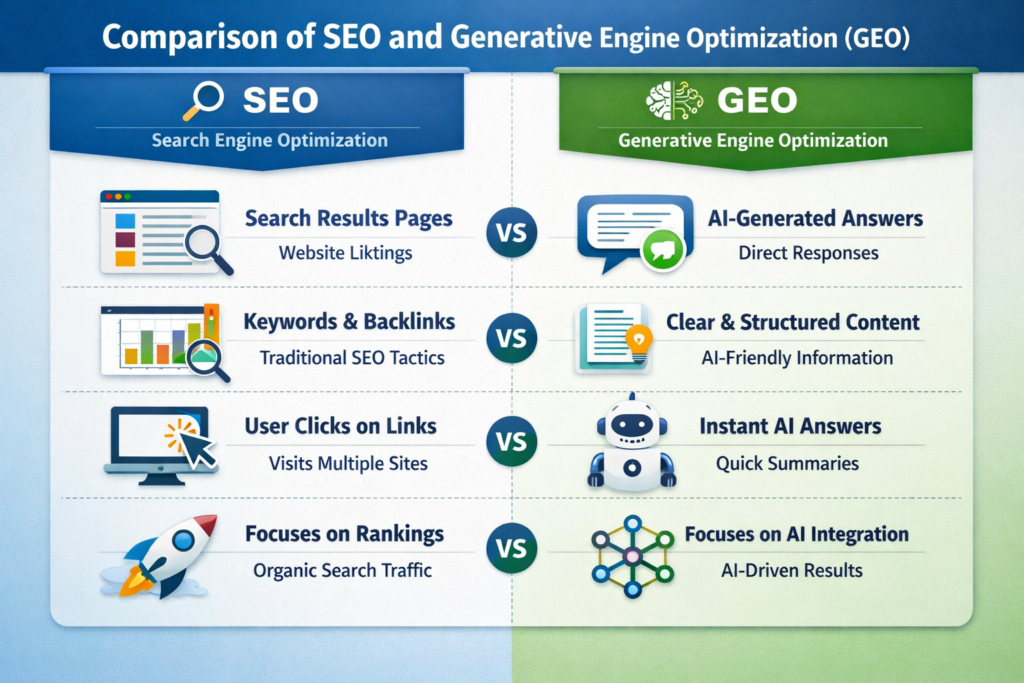
The concept of SEO vs. GEO is significant to those companies that wish to remain competitive in the contemporary digital environment. Although both strategies seek to raise the level of online visibility, they accomplish this goal in dissimilar manners and focus on varying forms of search experience.
What is meant by SEO (Search Engine Optimization)?
Search Engine Optimization (SEO) involves ensuring that a site is optimized to achieve the top position in the traditional search engine results pages ( SERP ). SEO ensures that websites rank high in search results when the users are seeking information on search engines.
SEO entails various methods of making the search engines perceive the significance and worthiness of a site. The methods involve key word research, creation of quality content, technical enhancement of the web site, and acquisition of back links through authoritative sites.
Indicatively, when an individual types in the query of the best freelance digital marketer in Kerala, the various sites are analyzed and the most relevant ones appear on the top pages. Websites with good SEO behaviors are likely to be ranked at the top of the first page.
These are some of the most relevant aspects of SEO:
- Keyword Optimization: It involves the use of relevant search words that individuals tend to enter in search engines.
- On-Page SEO: Optimizing headings, meta descriptions, photos, and internal links.
- Technical SEO: Making the site faster, and more mobile-friendly and
- performance-friendly.Backlinks: The acquisition of links with other reputable websites.
- User Experience: Creating user-friendly content that is accessible and interesting.
SEO as a digital marketing technique is over 20 years old and is still necessary in generating organic traffic to websites.
What is Generative Engine Optimization (GEO)
Generative Engine Optimization (GEO) is a more recent idea that aims at utilizing content to optimize AI-assisted search engines and generative artificial intelligence (AI) systems like ChatGPT, Google Gemini, and Microsoft Copilot.
In contrast to the traditional search engines that provide a list of links, the generative engines directly generate AI-generated answers by synthesizing the information of several sources. Users will not need to navigate through numerous websites and get a summed-up answer immediately.
GEO is interested in making sure that your content is included in the data utilized by these AI systems in coming up with answers. It implies that the objective is not only to rank in one of the results pages but to be mentioned or listed in the responses generated by AI.
In order to accomplish this, GEO strategies focus on:
- Development of clear, authoritative and factual information
- Organizing information in a simple to understand format
- Responding to particular user queries
- Offering credible and properly structured information
- The explanations should be context-rich
As an illustration, a user who poses the question to an AI assistant, What is the difference between SEO and GEO? the system provides an answer in a summarized form, as opposed to merely displaying a web list. GEO assists in making sure that your content is one of the reliable sources employed in that answer.
The most important Differences between SEO and GEO
Despite the fact that both SEO and GEO are aimed at enhancing the visibility online, they vary in terms of approach, objectives and presentation of search results.
- Type of Search Results
SEO aims at ranking sites on the conventional search engines results pages. Users will have a list of links and they get to select the page to visit.
On the other hand, GEO is concerned with AI-generated responses in which the system directly gives an answer, as opposed to a list of links.
- Optimization Strategy
SEO greatly depends on the use of keywords, backlinks, and technical optimization as it works to make search engines comprehend and rank a web site.
GEO emphasizes more on the clarity of content, power, and systematic information to allow the AI systems to extract and summarize the information effortlessly.
- User Experience
In conventional SEO, users tend to visit various sites to make the required information.
The AI system can give a full answer within GEO-based searches so that one does not have to go through several pages.
- Content Structure
SEO copy is commonly aimed at the position of the keywords and the optimization strategies in order to be ranked higher.
GEO content uses better explanations, natural language, and direct answers to questions that are easily understood by AI systems.
- Future of Search
SEO will not become less relevant due to the fact that traditional search engines remain significant contributors of a huge amount of web traffic. Nevertheless, GEO is becoming more relevant as the popularity of AI assistants and generative search tools is increasing.
Companies that are a hybrid of the two will be better placed digitally in future.
Why Businesses Should Focus on Both SEO and GEO
The digital search environment is rapidly changing as AI technology becomes more integrated into everyday search experiences. Businesses that rely only on traditional SEO may miss opportunities to appear in AI-generated answers.
By combining SEO and GEO strategies, businesses can improve their chances of being discovered through both search engine rankings and AI-driven responses.
For example, creating high-quality blog content, answering common customer questions, and organizing information clearly can help a website perform well in both traditional search engines and generative AI platforms.
As AI continues to shape how people search for information online, understanding and adapting to both SEO and GEO will become essential for digital marketing success.